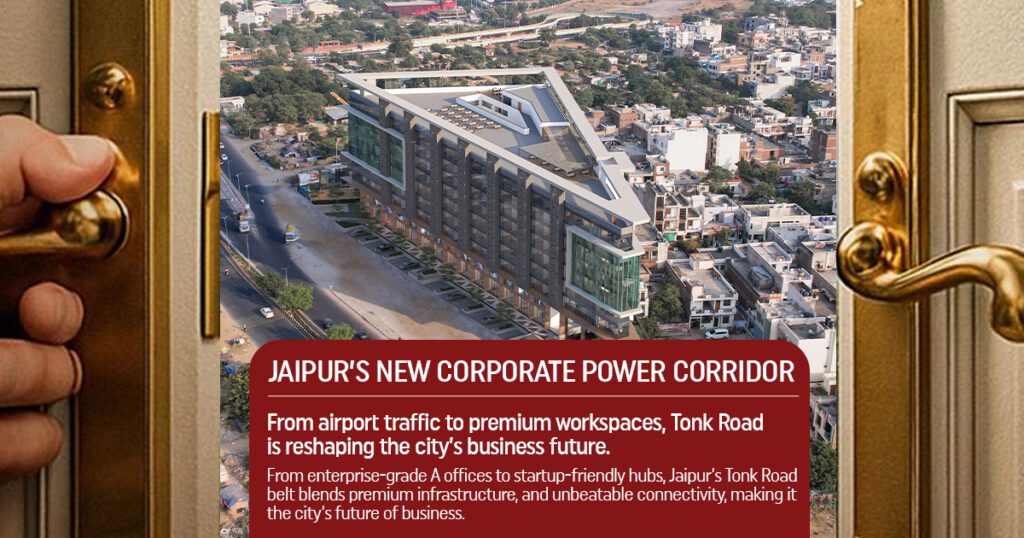
The Future of Business in Jaipur
Jaipur’s business landscape is shifting in the direction of speed, access and quality of workspace. The airport–Tonk Road belt has emerged as the city’s most strategic corridor, driven by better metro connectivity and increasing passenger numbers fueling Jaipur’s business growth in services, technology-enabled SMEs and healthcare. Jaipur International Airport served ~6.06 million passengers during FY2025 (+10.8% YoY), a direct indicator of client movement and commerce.
So we thought we would dig into a few questions, the why and the how, behind Jaipur’s emergence as a player in India’s corporate culture.
Why is Jaipur picking up speed with premium occupiers?
Three flywheels: (1) livability and talent retention, (2) national air connectivity, and (3) a mature services ecosystem. The airport belt is particularly appealing, Jaipur Airport to Tonk Road is a ~4–6 minute drive (2–3.5 miles), which condenses “land → meet → decide” for client-facing teams.
Which micro-markets will shape the next cycle?
The commercial expansion Tonk Road corridor (Tonk Road, B2 Bypass). It’s the axis between the airport, business hotels, RIICO nodes and settled residential catchment areas, an daily ecosystem instead of an isolated address.
What exactly is “premium office space Jaipur” in 2025?
More than glass and height. Premium today translates to enterprise-scale floorplates, solid vertical movement, multi-level parking, high uptime, and ESG readiness. Rajasthan passed 600+ IGBC-rated green buildings in 2025, indicating the way in which sustainability has shifted from “nice to have” to a base tenant expectation. If you desire future-ready office space Jaipur, shortlist properties that can credibly demonstrate their green and efficiency credentials.
Are there concrete numbers to back the airport belt hypothesis?
Yes, and they’re positive. Commercial office (sale) on Tonk Road clocked ~₹13,062/sq ft in Apr–Jun 2025, a +3% QoQ increase; the seen band was ~₹10,141–₹15,984/sq ft—healthy prices with room compared to Tier-1 cities. For investors and corporates, that means potential for appreciation once infra lands and demand sinks in.
How do “smart offices Jaipur” manifest on the ground?
By its friction-reducing solutions: secure digital access, intelligent lighting/HVAC, visitor management, EV readiness, and data-driven building operations. These capabilities reduce operating cost and make hybrid work effortless, why so many decision makers now make “smart” a hygiene factor and not a luxury in an urban business center in Jaipur.
How does Jaipur stack up against other emerging business districts in India?
Jaipur combines Tier-1 adjacency (quick flights) with affordability in occupancy cost and robust livability. Momentum on airport traffic (FY2025: 6.06 million passengers) highlights depth of market, while green adoption (600+ IGBC projects across the state) meets corporate RFPs. There are not many emerging business districts India has that combination of access, cost reason and sustainability this large.
What one-sentence checklist should we apply before we sign?
- Drive-time reality: airport in ≤10 minutes peak time; Tonk Road qualifies here.
- Road geometry: broad frontage and smooth ingress/egress (arterial width of Tonk Road assists).
- Throughput: elevator numbers and multi-level car parking (handling visitors at peak).
- Uptime & ESG: 100% power + valid green features (fit ESG checklists; reduced opex).
- Ecosystem: nearby hotels, cafés, hospitals, banking—absolute musts for client-facing teams.
- Is this just for big organizations or do startups also reap benefits?
Both. Enterprises want single-floor collaboration and dependable throughput; startups need credibility, access and layouts that scale without moving. A Tier-1-adjacent address in a modern business hub Jaipur helps close enterprise deals and host clients efficiently, valuable whether you’re a GCC, a clinic, a D2C brand or a SaaS team.
Where does Aekum Hub fit into this future?
Aekum Hub sits on the Tonk Road–B2 Bypass spine, the core of Jaipur’s next-cycle ecosystem. Its design prioritizes enterprise results (big, effective plates; robust circulation; multi-level car park) and timing (fit-out readiness synchronized with the existing demand window), making it an obvious choice for premium office space Jaipur. For startups, Aekum Hub translates to trust + agility: an airport-belt address that’s simple to access, easy to host in, and seamless to scale within. In short, for teams considering future-ready office space Jaipur, Aekum Hub delivers on all that this corridor has to offer—speed, visibility and uptime.
Bottom line: If your shortlist contains high-end office space Jaipur, keep your focus on commercial growth Tonk Road, test assets against the smart/ESG criteria, and balance how airport-adjacent access synergizes outcomes in the long run. Based on today’s numbers (pricing trend up ~3% QoQ, airport traffic at 6.06M pax), the corridor is poised for long-term performance — and that’s precisely the context in which Aekum Hub excels.


